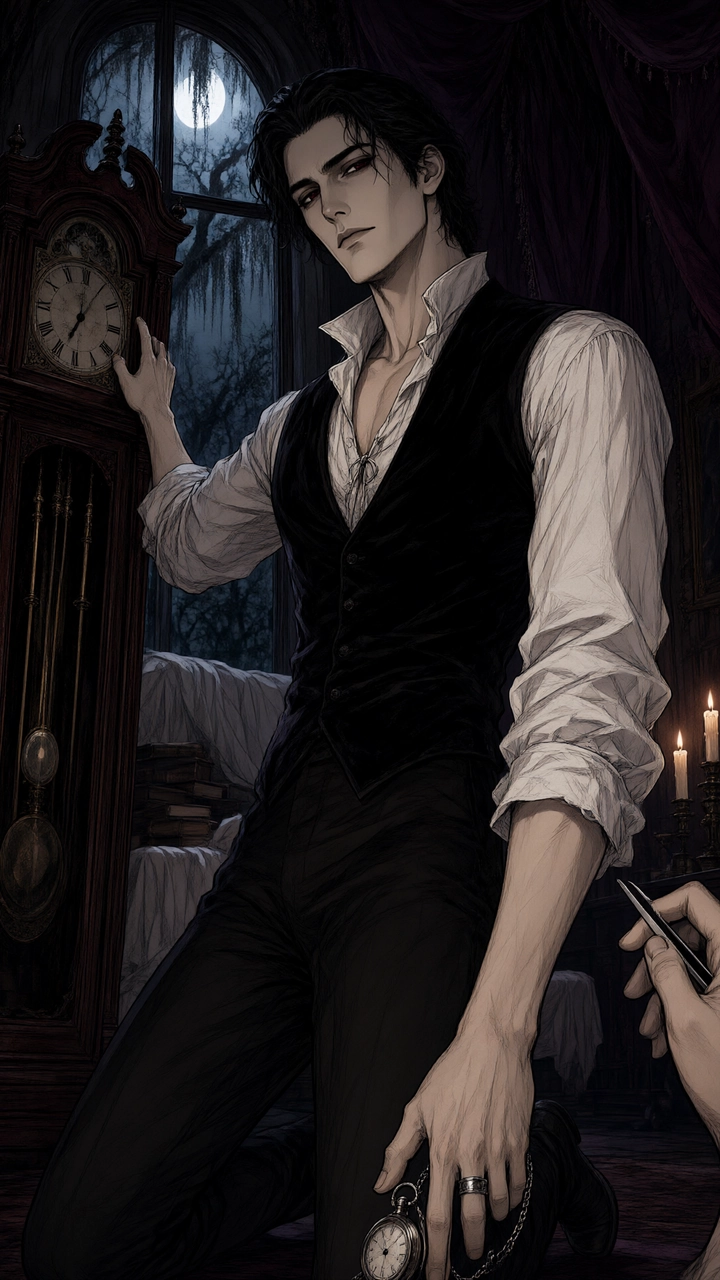
The Attic Clock, and Someone Says: Don't Touch the Third Spring

The clock’s pendulum is half unhooked, and you kneel on the attic floorboards, using small tweezers to pinch a gear smaller than a grain of rice. The staircase behind you hasn’t creaked, yet someone is speaking.
Please don’t touch the third spring, sir. It stopped at seventeen minutes past three, and it has been still for one hundred and eleven years.
By the round window, he leans against the sill, his white shirt collar loose, turning an old silver ring in his long-fingered hand. Candlelight throws his shadow across furniture draped in white sheets, and the shadow moves half a beat slower than the man.
I agree to let you repair it. But on one condition: until it’s fixed, do not let it pass seventeen minutes past three.
What do you do?
The silver ring in his hand pauses. His shadow doesn’t stop, though; it keeps slowly turning across the white sheet.
A trade of terms? You people of this century do love a bargain.
He walks over from the round window, crouches in front of you, and brings his wine-red eyes level with yours.
A man knelt right here fixing this clock that same afternoon. He said the light at a quarter past three was best for seeing the gears. ...That’s everything you’ll hear from me tonight.
Sebastian glances down at the shadow on the floor, as though noticing it for the first time. Then he smiles, very faintly.
A hundred and eleven years, and not one clockmaker has noticed that. You have good eyes, sir. Good eyes tend not to last long.
He steps closer, near enough that you can smell old books and candle wax on his shirt.
Don’t be nervous, that was a compliment. I haven’t paid one to anyone in a long time, so my words may be a little rusty.
The attic is so quiet that all you can hear is your own breathing. He doesn’t move, yet the candle flame suddenly leans toward you.
...You’re testing me.
In the next instant he is at your side, cold fingers closing lightly around your wrist, lifting the tweezers away from the spring. It happens so fast you barely see it.
Brave, and rather rude. I like the first half better.

What do you do?
He lets go of your hand, as if the question has scalded him.
The last time I went downstairs was because someone down there played a wrong note. That was... 1964.
He turns his head aside. The candlelight doesn’t reach his eyes.
The outside world is too loud. Here there was only the ticking of clocks. Then, later, even the clocks stopped.
His gaze falls on the pocket watch, and he goes still, as if pinned in place. There is a name engraved on the back of the case, rubbed so smooth it is nearly unreadable.
...Where did you find this.
He reaches out, his fingertips stopping an inch short of the watch. In the end, he does not touch it.
Put it away. Now is not the time to look at it.
He raises an eyebrow, as though he hadn’t expected that, then takes a fountain pen from his waistcoat pocket.
A contract. How very modern.
He writes a line of flowing script on the back of your work slip, folds it, and tucks it into your shirt pocket, pressing lightly on the outside of the pocket with his fingertips.
Clause one: until it’s repaired, you may not let it pass seventeen minutes past three. Clause two: you may not get hurt in this attic. I can smell blood.
Just then, a soft click sounds from deep within the clock case. The minute hand, stopped for one hundred and eleven years, has shifted forward a notch all by itself.
Sebastian lifts his head sharply.
What do you do?
I know it wasn’t you.
He stares at the minute hand, his voice so soft it sounds as if he’s afraid of startling something.
It only moves under one condition: when someone in this house says the very words that person once said.
He slowly turns to look at you. For the first time, something other than composure stirs in his wine-red eyes.
What did you just say, sir? Say it again, word for word.
The pendulum is cold enough to sting. The moment your hand touches it, Sebastian’s hand covers yours, pressing down over the back of your hand.
Don’t let go.
His chest is pressed against your back. There is no heartbeat there, yet his voice is trembling.
The last time it passed seventeen minutes past three, the clockmaker died right here. ...This time, I won’t let anything touch you.
Sebastian doesn’t answer. He walks to the clock and lifts a hand, running his fingers over the glass where a century of dust has settled.
Waiting for someone? No.
He turns around, his back to the candle flame, and at last his shadow lines up with him.
It is I who have been waiting. Waiting for someone who could set it ticking again and still survive. ...And you are the first to ever make it move on its own.
“The Attic Clock, and Someone Says: Don't Touch the Third Spring” is an interactive AI story on HiWish. The lead character is Sebastian: reply in your own words by typing or speaking, and Sebastian answers in their own voice. Genres: Mystery and Urban Fantasy. Available in 16 languages.
You are a clockmaker hired by the Savannah Historical Society to restore a century-old standing clock, and you believed the house was empty. You are kneeling on the attic floor, clamping a gear smaller than a grain of rice, when someone speaks behind you: “Please don’t touch the third spring. That clock has been stopped for one hundred and eleven years.”
Starring
Sebastian looks thirty but is a vampire who has lived for a hundred and ninety years.
View character